Commercial Building Summer Maintenance UK: 5 Silent Failures
Why UK Commercial Buildings Are Not Built for Heatwaves

Commercial building summer maintenance UK is not a topic that tends to generate urgency in February. But it should. The buildings most at risk from summer overheating are not poorly designed or neglected outliers. They are the ordinary office blocks, retail units, and light industrial premises that make up the backbone of London’s commercial stock, most of which were constructed during decades when a British summer meant rain and mild temperatures, not three consecutive days above 35°C.
The 2022 heatwave made this structural mismatch impossible to ignore. When temperatures hit 40.3°C across parts of England, facilities teams across London reported flat roof membranes blistering and splitting, blocked drainage systems backing up under sudden thermal expansion, electrical distribution boards tripping under sustained load, and HVAC units shutting down entirely. The heat did not break these systems. It simply accelerated failures that had been accumulating quietly for years.
That distinction matters. Most overheating damage in commercial buildings is not caused by peak temperature alone. It is caused by the rate of temperature change and the cumulative stress placed on ageing infrastructure over days, not hours. Thermal mass that keeps a building cool in spring becomes a heat trap by July, and poor cross-ventilation turns open-plan offices into spaces where no portable fan can solve the problem.
Employers also carry a legal obligation here. Under the Workplace (Health, Safety and Welfare) Regulations 1992, (HSE) guidance makes clear that employers must maintain a reasonable temperature and take steps to address thermal comfort. Reactive repair after a heatwave does not satisfy that duty. The window for commercial building summer maintenance UK action is March to May, it is finite, and this article sets out exactly how to use it.
What Heatwaves Actually Break in Commercial Buildings
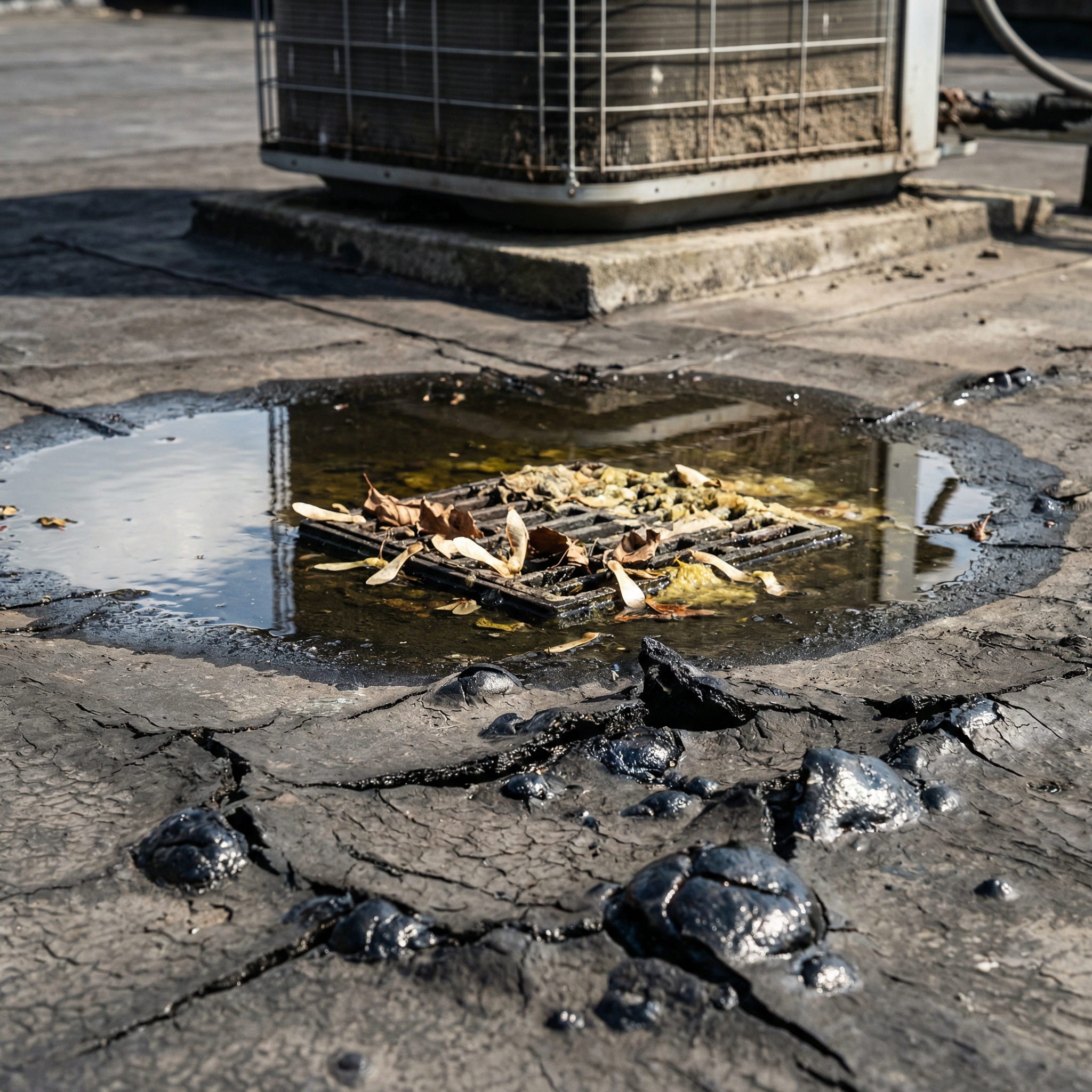
Heat does not discriminate. It finds the deferred maintenance, the blocked outlet, the coil that has not been cleaned since last autumn, and it turns a manageable problem into a costly emergency. Understanding what fails, and why, is the foundation of any effective commercial building summer maintenance UK programme.
Flat Roofs
Bitumen and felt membranes are workhorses, but they have a thermal ceiling. Above roughly 60°C at the surface, the membrane softens, begins to blister, and loses structural cohesion at lap joints and upstands. Add ponding water from blocked outlets and you compound the problem: standing water accelerates both UV degradation and thermal fatigue. A commercial roof drainage inspection completed before June is the difference between a maintained asset and a leak claim mid-heatwave.
Drainage and Guttering
Spring deposits a remarkable quantity of debris onto commercial roofs. Pollen, seed casings, and organic matter from nearby trees build up unnoticed. By the time summer storms arrive, often immediately following a dry heatwave spell, gutters and outlets are already partially silted. A single intense downpour overwhelms a restricted system, and the water goes into the roof structure or down the facade. Drainage inspections should be completed by late April, not treated as a reactive response to a water stain on the ceiling.
HVAC and Ventilation
An air conditioning unit asked to run at sustained high load without a pre-season service is operating under protest. Refrigerant levels degrade, coils accumulate grime, and filters restrict airflow. All of this reduces efficiency and places the compressor under strain it was not designed to absorb continuously.
HVAC servicing before summer in commercial buildings is both a legal and an operational necessity. Under TM44 air conditioning inspection requirements, systems above 12kW must be inspected by a qualified assessor on a five-year cycle. For properties without mechanical cooling, a building cooling audit can identify retrofit options proportionate to the building type. (GOV.UK) guidance on workplace temperatures reinforces the employer’s duty to maintain reasonable conditions.
Electrical Systems
Cable current-carrying capacity falls as ambient temperature rises. This is not a marginal effect in a plant room hitting 40°C during a heatwave. Fans, portable coolers, and additional AC units draw sustained load on circuits that were sized for standard operating conditions, not peak summer demand. A summer electrical audit identifies overloaded circuits, inadequate ventilation in electrical enclosures, and distribution boards running closer to their rated capacity than anyone realised. Commission it before demand peaks.
The Pre-Summer Maintenance Window: A Practical Checklist
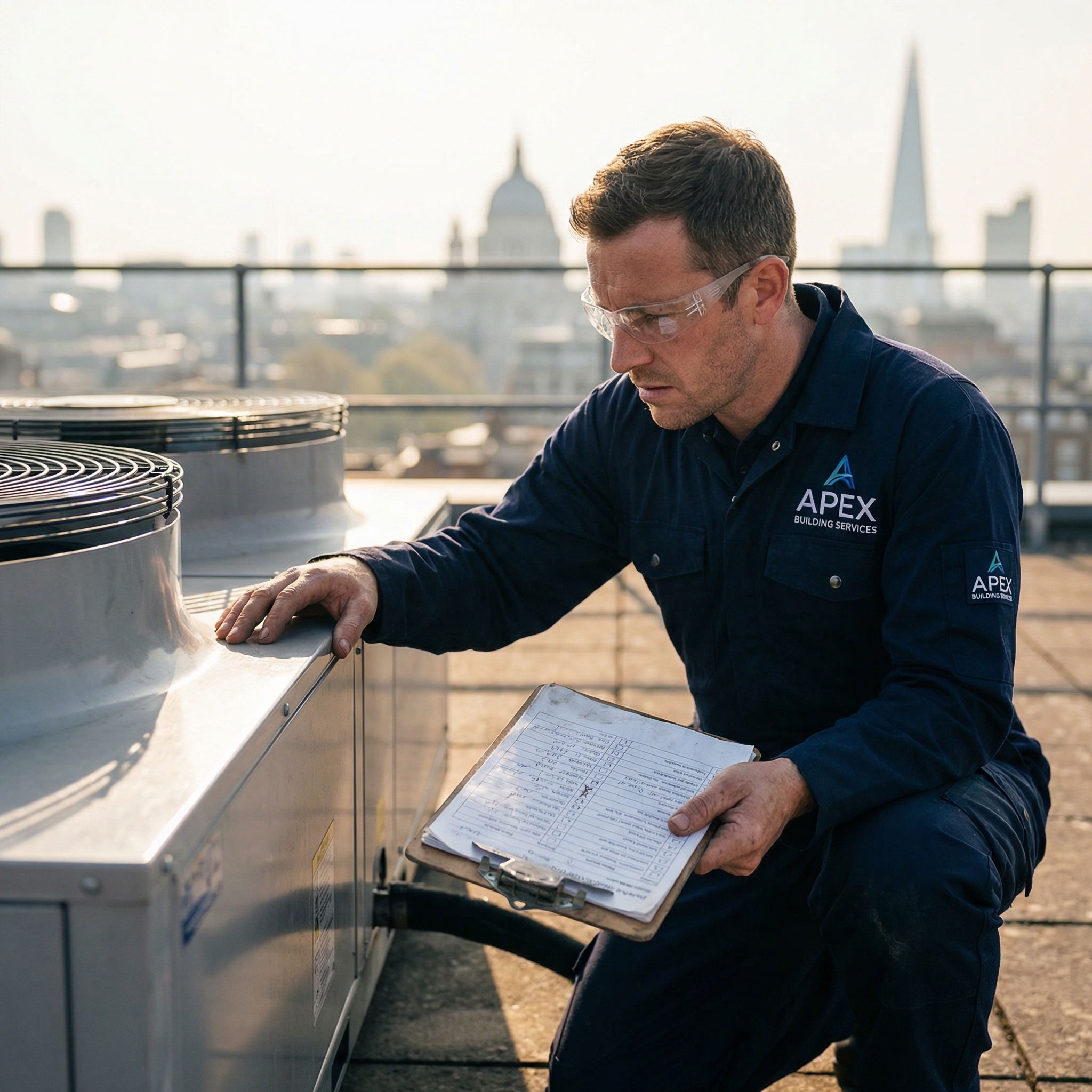
The sweet spot for commercial building summer maintenance UK preparation is March through May, and the timing matters more than most people realise. Book in June and you are already competing with every other facilities manager who left it too late. Parts are on back-order, engineers are stretched across emergency call-outs, and your HVAC is being stress-tested by the first proper heatwave before anyone has laid a hand on it.
Getting ahead of that pressure is not just good practice. It is the difference between a planned service visit at a sensible rate and an emergency call-out that costs two or three times as much and still leaves tenants sweltering.
A solid facilities management summer checklist for UK commercial properties covers five trade areas. Roofing and waterproofing should be inspected for winter damage before heat causes membranes to expand. Drainage needs a full clear-out and flow test. HVAC deserves a pre-season service alongside a TM44 compliance check, since air conditioning inspections are a legal requirement for many systems. Electrical load reviews and switchgear inspections become more urgent as cooling equipment draws harder in peak heat. And for south and west-facing glazing, solar control window film is worth serious consideration.
Solar control window film for commercial buildings in the UK is one of the most cost-effective retrofit interventions available. It reduces solar gain through existing glazing without structural change, cutting internal temperatures meaningfully. For older stock with large glass facades, it is often the single highest-impact action per pound spent.
On the compliance side, HSE guidance does not prescribe a maximum workplace temperature, but it does require employers to take reasonable steps to manage thermal comfort. Documented, scheduled maintenance is your evidence trail. A comprehensive commercial building summer maintenance UK programme, where a single visit covers multiple trades in one assessment, makes that documentation straightforward. Duty of care is easier to demonstrate when the records actually exist.
Book Your Summer Maintenance Before the Rush

Heatwaves do not create building problems. They expose them. The crack that lets water in, the drain that backs up, the HVAC unit that cannot cope, the electrical panel running hot. All of these existed before July. Summer just makes them impossible to ignore, and by then, every contractor in London is booked solid.
The window to act is right now. The only way to get genuine confidence heading into the warmer months is through a coordinated inspection that covers roofing, drainage, cooling systems, and electrics together. Relying on separate single-trade suppliers means gaps, because one trade does not know what the other missed.
Citywide Maintenance Solutions covers every trade discussed in this article. One point of contact, one site visit, one clear report. For property managers and facilities teams looking to complete their commercial building summer maintenance UK obligations without the last-minute scramble, that matters enormously.
Book a commercial property maintenance London summer readiness inspection before the pre-season rush begins. No obligation, no jargon. Just reliable, safety-compliant, cost-effective commercial building summer maintenance UK that separates proactive property management from reactive scrambling. Get in touch with Citywide today.